
1.What types of printing do you offer?
We offer offset printing up to B1. Choose offset for demanding print, especially in larger runs, when using special materials (paper over 350 g/m²) and when you need complex finishing.
We also offer digital and wide-format printing.
2.How do I get my print?
First the print is designed and the printing method chosen. You send us a request for a quote via the online form, by email or in person. We advise you on materials, optimise the run length and set the other print parameters. We prepare the design files for printing; for offset we also make the printing plates.
We deliver free of charge anywhere in Slovenia. We also deliver within the EU.
3.How do I order?
Visit us between 7:00 and 15:00 at Kotna ulica 5 in Celje, send a request via the online order form or call our sales representative on +386 3 425 66 34. We will reply as soon as possible.
4.How do I submit print files?
Bring the files in person, send them by email or attach them to the online order. For high-quality, economical production in the shortest time, we recommend preparing files according to graphic standards.
5.What kind of files do you need?
- Open files from PC and Mac (Adobe Illustrator, Adobe InDesign, PageMaker, QuarkXPress, CorelDRAW, FreeHand, Microsoft Office and others). Include the fonts used (Type 1 or TrueType) or convert them to outlines. Images should be TIFF or JPG, CMYK, 300 dpi. Such files need some additional preparation.
- PostScript (PS) files, ready for print: select a PostScript printer, the appropriate PPD and 2400 dpi, and create the file with Print to File. Allow 3 mm bleed and save colours in CMYK, composite.
- PDF print files take up less space (up to 10 times less at the same quality). Create the PDF by converting the PS file with Adobe Acrobat Distiller using the Press setting.
6.I have a PDF or PS file. How do I submit it?
Send the PDF or PS file by email or on a portable medium. We accept larger files by email, but not files from FTP addresses. Save larger publications as a single file. When ordering film, include paper printouts.
If you have no PDF or PS file, files may come from PC or Mac, from graphic or office programs. Compress large files with ZIP. Files should be in CMYK. Do not embed ICC profiles unless agreed in advance.
7.What information do you need with an order?
- Client: address, VAT number, contact person and other contact details
- Order: subject, quote reference, payment method, deadlines
- Print: printing method, format, number of pages, paper, single- or double-sided, number of colours, run length, finishing
- Material: samples, colour references, file names and how files will be delivered, films
- Finishing: trimming, folding, binding, personalisation
- Delivery: address and date, contact person
8.What is print design?
Based on your idea, the designer creates a draft, defines the format according to your wishes and needs, selects materials, typefaces, colours and images, and produces samples. Prepress follows.
9.Who prepares the material for print, and how?
We check and technically process the images, produce proofs, fix errors, enter corrections, prepare the page imposition and technically prepare the files for plate imaging or digital printing.
10.How do I choose the right printing method?
- Run length: for small quantities, from one to a few hundred copies, digital is often the most economical.
- Lead time: digital allows almost immediate printing; offset needs at least two working days from receipt of the PDF files.
- Material: we print digitally on paper up to 350 g/m²; offset has almost no such limits.
- Format: offset up to B1.
- Quality: in offset we can use any Pantone colour in addition to the process colours.
- Price: digital is cheaper for small quantities, offset for large runs.
11.Digital or offset?
Digital printing is better when you need a small number of copies within a few days; it is more economical for runs from one to a few hundred copies.
Offset suits demanding print and larger runs, including special papers. Besides the process colours, all Pantone colours can be used. Production takes longer, usually a few days, and also depends on finishing (folding, trimming, die-cutting, lamination, varnishing, binding).
12.How do I choose a material?
Choose from woodfree papers and boards, matt and gloss, recycled, special and tinted papers, papers with special effects and textures, and self-adhesive and transparent papers from 50 to 650 g/m². A wide range of standard and non-standard envelopes is available. We advise you on the choice and can source the paper.
13.What is print finishing?
We refine print with precision trimming, lamination, foil printing, UV varnishing, folding, gluing, stitching and blind embossing.
For softcover binding choose from perfect binding (glued or sewn spine), stapling, sewing or spiral binding. For hardcover, Italian or case binding is available, with reinforced jacket, covers or whole product, plus decorative elements and ribbon markers.
14.How do you ensure quality?
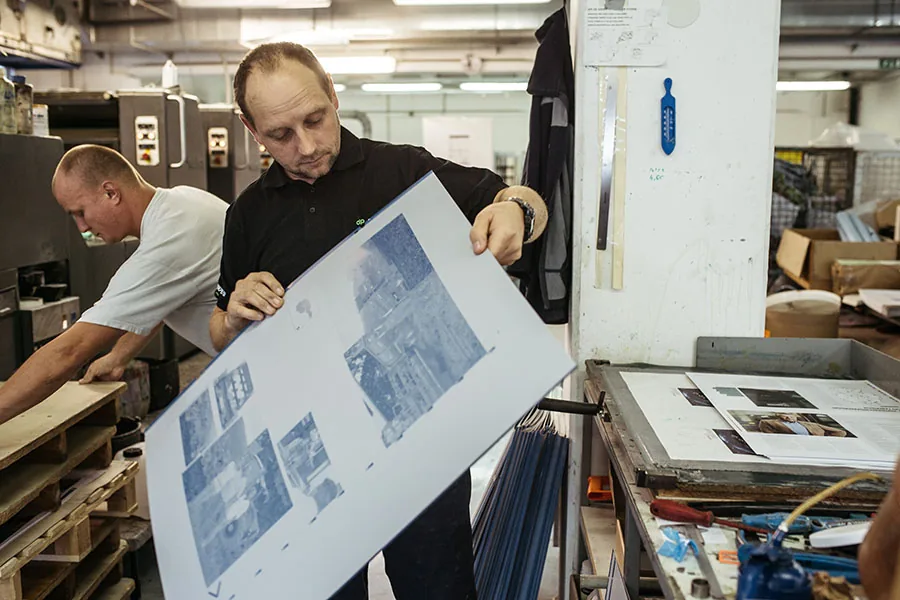
Before printing we check files or films and alert you to any errors. We can produce blueprints and proofs to check the position of elements, dimensions and finishing marks one last time. You can approve and correct colour proofs during printing; we compare them with samples and references.
We monitor print quality throughout the whole print cycle and during finishing.
15.What are your lead times?
Small digital runs can be ready within a few hours; offset takes longer. We always try to keep lead times as short as possible.
Planning a print job?
Send us an enquiry and we will prepare an estimate of the printing costs. You are also welcome to visit us in Celje.