
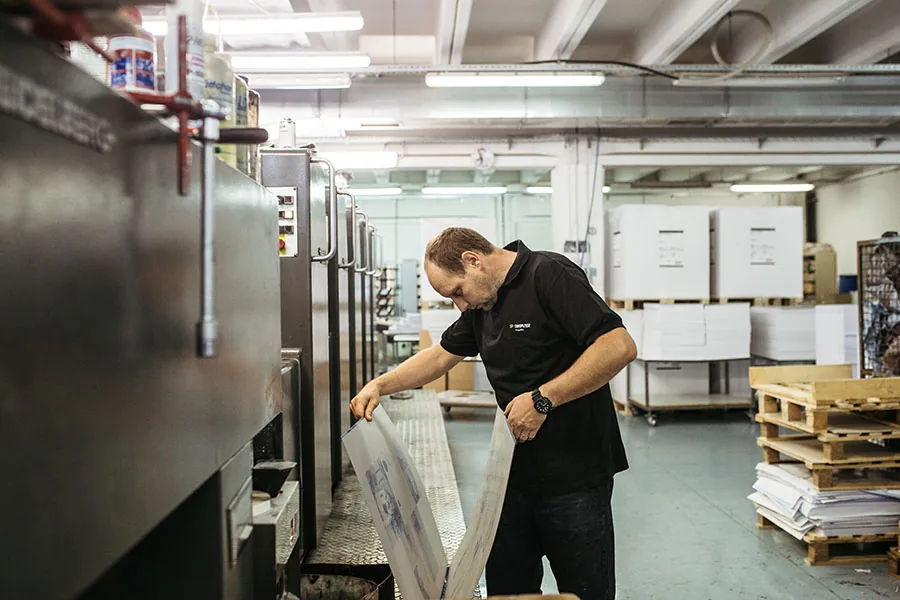
When to choose offset
If you want your print to reach many people, for example with leaflets in letterboxes, offset printing is the best choice. It offers high image quality at comparatively low cost: the more copies, the lower the price per copy.
Offset is also the right choice for demanding jobs, special materials (paper over 350 g/m²) or complex finishing. Besides the process colours we can use any colour from the Pantone guides.
How it works
The image is transferred via two cylinders, hence the name. The plate cylinder transfers the inked image to the offset cylinder, which prints it onto the substrate. The interplay of water and ink is crucial: the inks are water-repellent, so water on the chemically treated plates defines the image areas very precisely. Lines are sharp and images exceptionally clean.
How we print
- We print without alcohol.
- We use vegetable-based inks.
- Before printing we produce a colour-accurate contract proof according to the internationally recognised Fogra standard.
What we print in offset
- Business stationery: letterheads, business cards, folders, forms, notepads
- Advertising: brochures, flyers, catalogues, posters, price lists, calendars
- Periodicals: magazines, newspapers, newsletters
- Other: booklets, labels, books, stickers
- Packaging
Offset or digital?
For large quantities we recommend offset, as it is more economical for longer runs. For a few copies we recommend digital printing, which needs no special preparation and is faster.
Because plates have to be made, offset production takes at least two working days from receipt of the PDF files. The lead time also depends on finishing such as folding, trimming, die-cutting, lamination, varnishing and binding.
Photos
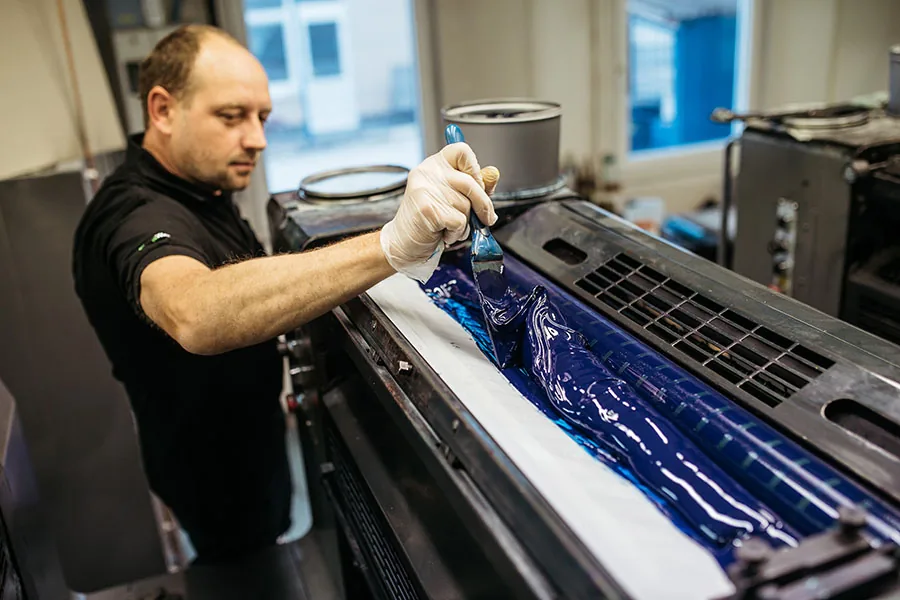
Adding ink to the ink duct of an offset press 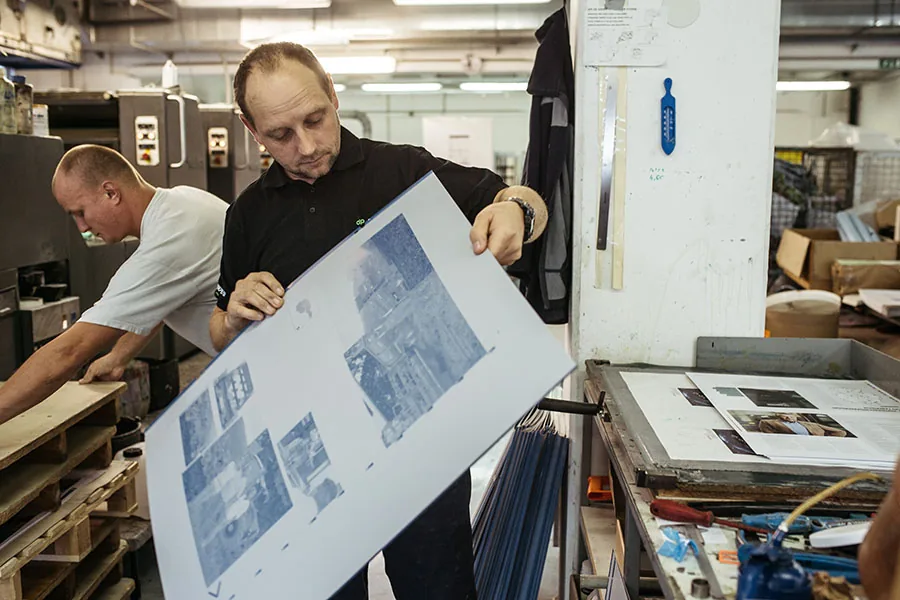
Inspecting a printing plate 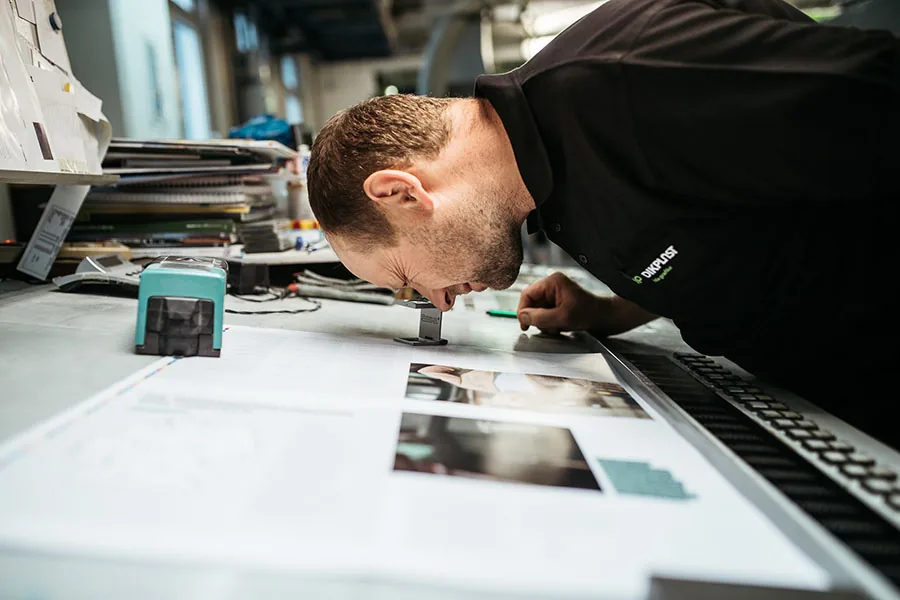
Checking a print with a magnifier
Planning a print job?
Send us an enquiry and we will prepare an estimate of the printing costs. You are also welcome to visit us in Celje.